top of page

Read the Canine - Dont Hit him
Updated: 2 days ago

“Most upper 1st premolar implant mistakes don’t come from lack of skill — they come from not reading the canine.”


Good morning, ChatGPT. Good morning, world. Good morning, Lisbon.


Today we’re finally hitting 25°C. Real spring. I just finished an amazing climbing session — one more step toward conquering my 6C+ . Today I fell on a move I had never reached before. It was a nice feeling because a lot of people was watching and i´m baby steps to close the 6 deal and move to the 7A tackle ! Stay tuned for next week … I will do this one !!!


And that, by itself, is progress.


Because in climbing — and in implant dentistry — it’s not about reaching the top. It’s about going further than yesterday.


From Beirut to Lisbon… to real-life dentistry


I was supposed to be in Beirut with Elena for a nice IEXcel launch by Straumann. A childhood dream — to see Fenicia, the port, the history.

But geopolitical reality had other plans. The Middle East is at war, and no plane goes in or what a mess......


And suddenly, I was in Lisbon.Sunday. Family lunch. Burger in hand. Kids in the restaurant !! No clinical plans.

Until…Margarida calls me.


“We have a patient. She wants implants. Now.”


No guide. No navigation. Just experience.


So it's 2 in the afternoon, I´m in a call with Mayra from Straumann in the car and suddenly shift course to the clinic for implant placement !!!

10 mn after I’m there to start the case a look at the medical history , to the CBCT agreement light and off we go !!


This is the real message of this case:


👉 What do you do when you don’t have a surgical guide?👉 When you don’t have dynamic navigation?👉 When all you have is… your expertise?


The so-called analog mode, in other words, lets go with the anatomical landmarks to do the implants in the correct prosthodontic position!


The problem - 2 Premolars to replace with 14 in a healed ridge and 15 in an immediate implant placement, both with immediate loading with non-occlusal contacts and 2 lower molars. Let's go !!!

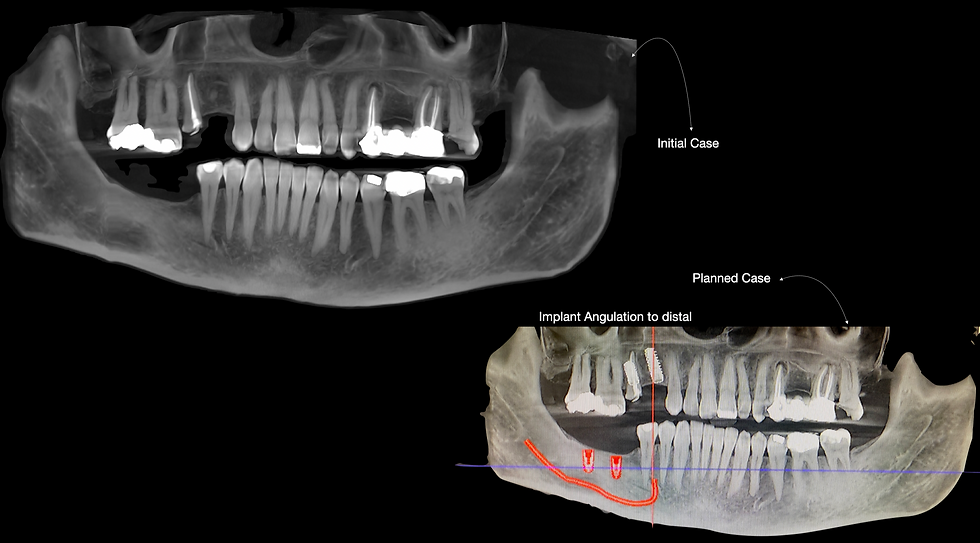
Dental examination reveals a root fragment and soft tissue defect, indicating the initial clinical situation requiring further intervention.

CBCT planning illustrating the distal angulation of implants 24 and 25 to strategically avoid the canine root tip.

The classic premolar mistake


I have seen may mistakes from students and myself and for sure One of the most common errors I’ve seen — especially when I was teaching — is this:


➡️ Placing a premolar implant and hitting the canine root apex.


Why?

  • The canine root is distally angulated

  • The crown is more upright

  • The operator follows the crown…


    ➡️ and the implant apex goes straight into the canine - a classy Phil as in the hangover movie …


A classic — and avoidable — mistake.


Read the canine (the key nuance)


Digital renderings of dental arches and teeth captured using an intraoral scanner, showcasing the detailed precision of STL modeling for dental procedures.


Understand the true nature of the anatomy you are discussing

In this case, everything comes down to one principle:


👉 Read the canine. Read The root, read the tip

Not the crown.Not the space.Not your intuition.

👉 The canine.


More specifically:

👉 Align the bisector of the crown axis with the distal margin and the distal slope of the canine cusp

This alignment serves as your invisible surgical guide. It will give the point of entrance and the correct Axis


Distal Angulation of the Canine. The distal angulation of the canine refers to the angle formed between the long axis of the canine tooth and a reference line that is perpendicular to the occlusal plane. This angulation is critical in various dental procedures to ensure proper alignment and positioning of the canine in relation to adjacent teeth. Illustration of Anatomical Landmarks. An illustration demonstrating the use of anatomical landmarks can be beneficial in guiding dental procedures. Key elements to consider include: Canine Position: The exact location of the canine in the dental arch. Adjacent Structures: Identification of nearby teeth, nerves, and blood vessels to avoid damage during procedures.   Reference Lines: Use of perpendicular lines to the occlusal plane for accurate angulation.Landmarks: Notable anatomical features such as the maxillary sinus or mandibular canal that may influence treatment. Utilizing these landmarks effectively ensures that dental procedures are performed safely and with precision, minimizing the risk of complications.
Distal Angulation of the Canine. The distal angulation of the canine refers to the angle formed between the long axis of the canine tooth and a reference line that is perpendicular to the occlusal plane. This angulation is critical in various dental procedures to ensure proper alignment and positioning of the canine in relation to adjacent teeth. Illustration of Anatomical Landmarks. An illustration demonstrating the use of anatomical landmarks can be beneficial in guiding dental procedures. Key elements to consider include: Canine Position: The exact location of the canine in the dental arch. Adjacent Structures: Identification of nearby teeth, nerves, and blood vessels to avoid damage during procedures. Reference Lines: Use of perpendicular lines to the occlusal plane for accurate angulation.Landmarks: Notable anatomical features such as the maxillary sinus or mandibular canal that may influence treatment. Utilizing these landmarks effectively ensures that dental procedures are performed safely and with precision, minimizing the risk of complications.


Clinical execution

Implant 14 (healed ridge)

  • Reference: distal slope of the canine

  • Preparation up to 2.8

  • Implant: 3.5 x 12 BLX

  • Direction pin to confirm axis


Implant 15 (post-extraction) — the real challenge

Here’s where finesse matters.

We need to achieve three things simultaneously:

  1. Anchor in the palatal bone

  2. Maintain parallelism with 14

  3. Avoid the Molar root and the mesial implant


Strategy:


  • Initial drill entry:


    👉 45° toward the buccal

  • Then:


    👉 Redirect toward the palatal bone (for anchorage)


    👉 Slight adjustment toward mesial (for parallelism)


💡 This 3D movement is everything.


If you miss it:

  • you lose stability

  • or you lose alignment

  • or you hit the canine


Pilot confirmation of the precise 3D positioning of dental implants using depth indicator parallel pins for proper alignment and anchorage.


Outcome

  • Implant 24: 3.5 x 12 PLX

  • Implant 25: 4.0 x 8 PLX

  • Excellent primary stability


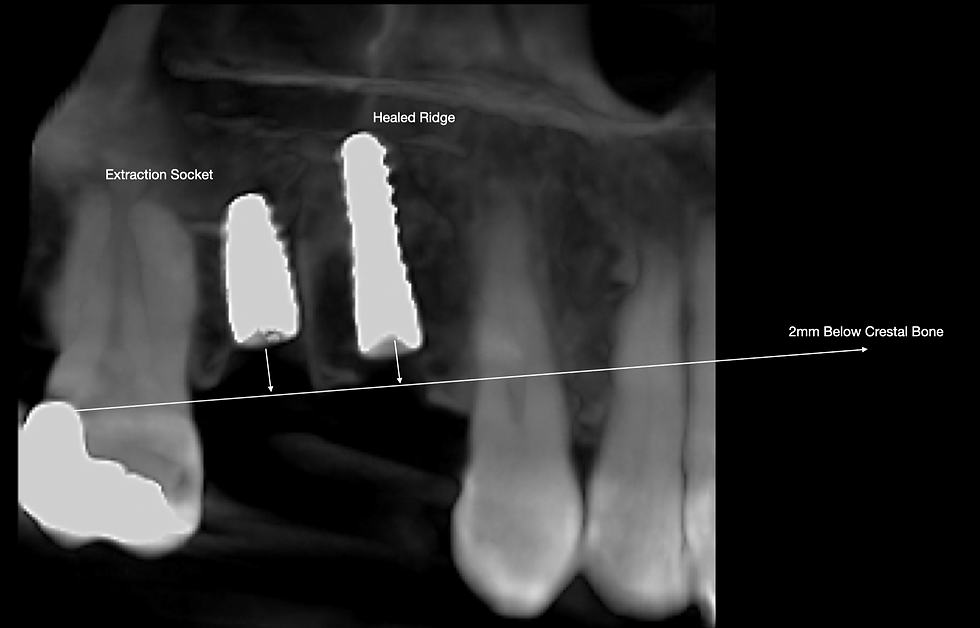
CBCT imaging confirms the parallel positioning of tooth #14 relative to the canine tip, highlighting the healed ridge and extraction socket 2mm below the crestal bone.


CT scan illustrating immediate implant placement and loading, highlighting key anatomical landmarks and implant orientation, including the extraction socket, buccal and palatal plates, and the nasal cavity.


Restoration

  • SRA 2.5 abutments

  • Direct relining of provisional crowns

  • Immediate loading without occlusion

  • Jumping gap filled with xenograft

  • Sutured with provisionals in place

Result:👉 Two implants👉 One delayed + one immediate👉 Parallel👉 Biologically stable👉 Prosthetically functional


Take-home message

When you don’t have technology…

👉 You must become the technology.

Read anatomy. Trust your mental map. Execute with intention.


And finally…

Friday ended the right way:

👉 A big açaí👉 Zero guilt👉 And the feeling that we did things right


Comments


Grow your
vision with us

© DocsinDentistry 2025

About Us

Courses

Talks & Interviews

Projects & Portofolio

Blog

Contacts

About Us

Courses

Talks & Interviews

bottom of page